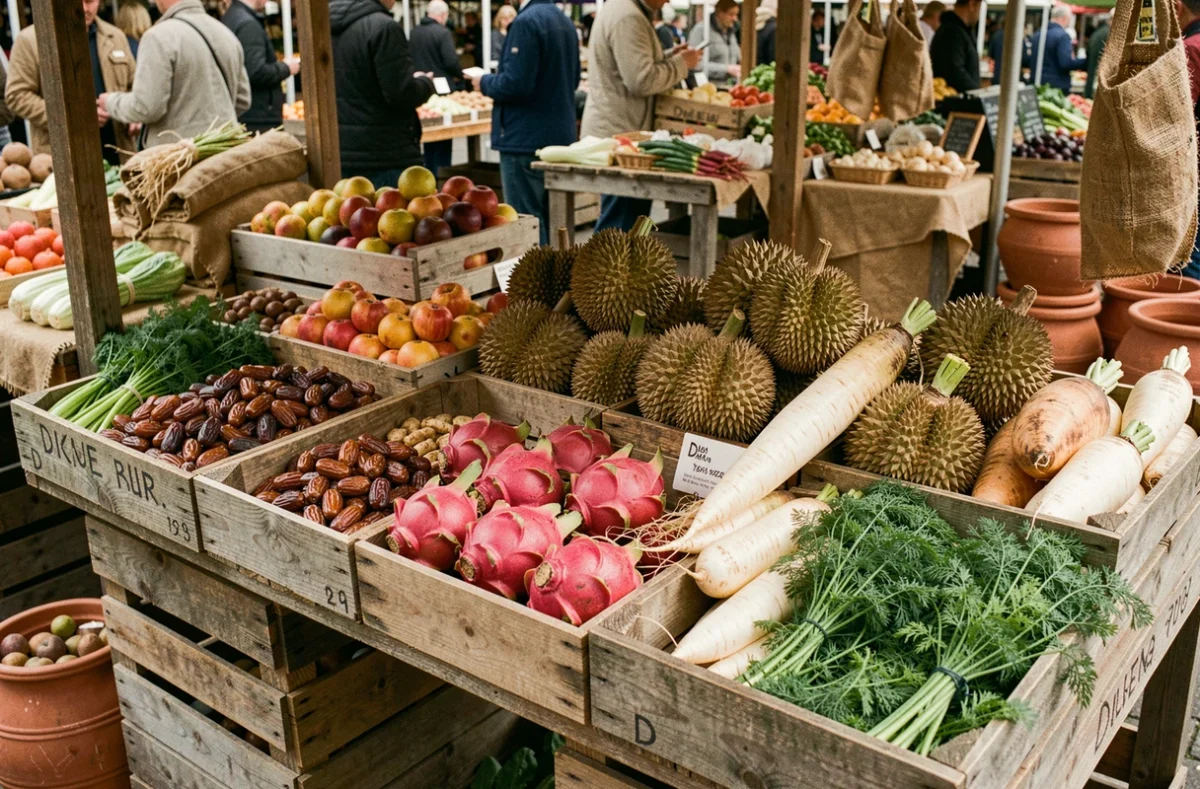
In the kitchen, the letter D brings to mind dates, daikon and durian. These names often come up in quizzes, word games and food searches.
The botanical classification of these foods does not always match how they are used in cooking: scientifically, a fruit is the organ that develops from the fertilization of a flower, while the word “vegetable” has no formal place in botany. Each name beginning with D therefore deserves to be examined individually.
Fruit or vegetable: why botany recognizes only one of these categories
The word “fruit” has a precise scientific definition. In botany, a fruit is the structure that develops from a flower’s ovary after fertilization. It contains the plant’s seeds. Tomatoes, cucumbers and peppers are botanical fruits, even though they are classified as vegetables in cooking.
The word “vegetable,” on the other hand, has no equivalent in botanical classification. It is a culinary term that groups together very different plant organs: roots, stems, leaves, bulbs, tubers and, sometimes, botanical fruits eaten in savory dishes. So when someone asks, “What vegetable starts with D?”, the answer depends on which classification system they have in mind.
This distinction changes how we read a simple alphabetical list. Among fruits and vegetables beginning with D, some names refer to fruits in the strict sense, while others refer to roots or tubers that are classified as “vegetables” only in culinary usage.
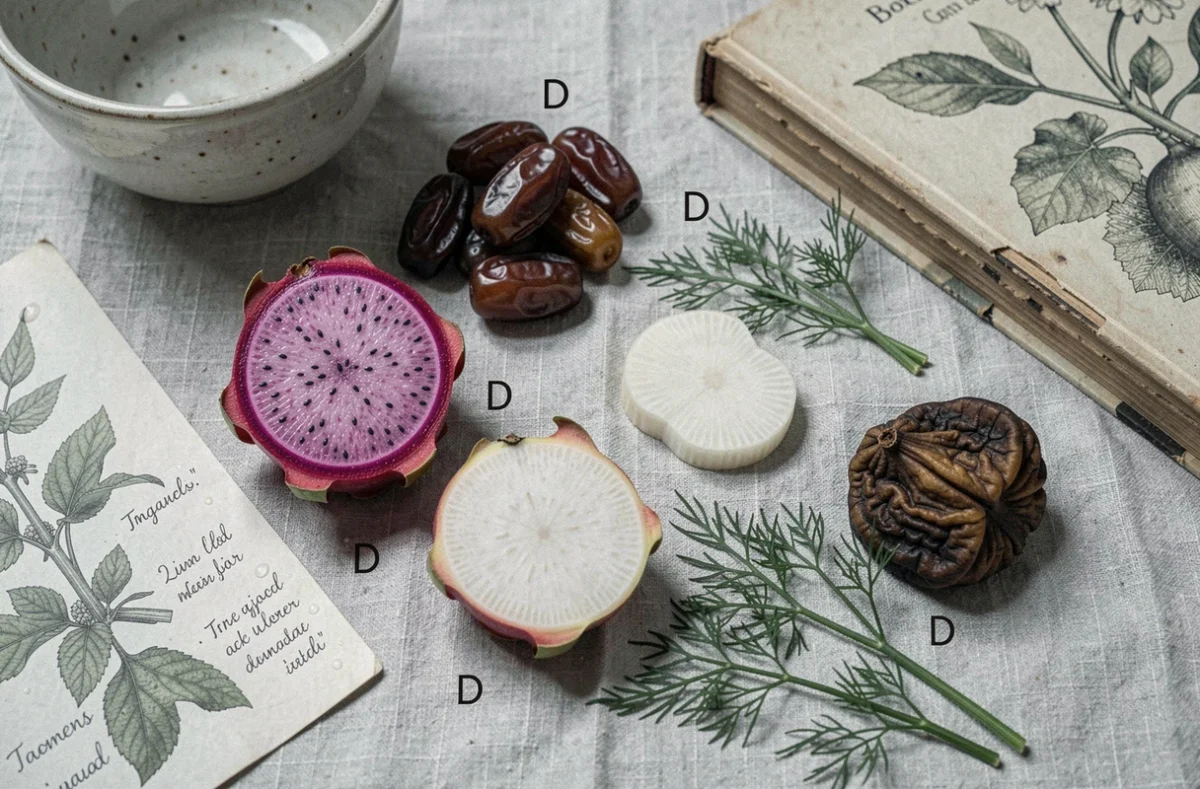
Dates and durian: two botanical fruits beginning with D that should not be confused
Dates and durian are among the fruits beginning with D that are mentioned most often. Their only common feature is their initial letter: their botanical structures are quite different.
The date, fruit of the date palm
The date comes from the date palm (Phoenix dactylifera). It is a fleshy fruit whose inner layer, next to the pit, has a papery texture. This sets it apart from a typical stone fruit such as a cherry or peach. Dates are eaten fresh or dried, and their classification as fruit is not disputed under any system.
Durian, fruit of Durio zibethinus
Durian is the fruit of the Durio zibethinus tree, native to Southeast Asia. Its thick, spiky shell protects creamy flesh with a very strong smell. Botanically, durian is a dehiscent capsule, meaning that it splits open when ripe to release its seeds. Its structure has nothing in common with that of a date.
These two examples show that a list of “fruits beginning with D” brings together plant organs whose morphology, seed dispersal methods and botanical families have nothing to do with one another.
Daikon and dasheen: vegetables beginning with D that refer to different plant organs
When it comes to “vegetables,” daikon and dasheen often appear on lists. Grouping them under the label “vegetables beginning with D” obscures a more nuanced botanical reality.
- Daikon is a white radish belonging to the species Raphanus sativus. The part we eat is a large, often bulky taproot that grows underground. Botanically, it is classified by the organ (root), not by a “vegetable” category, which does not exist in plant science.
- Dasheen refers to taro (Colocasia esculenta), also known as colocasia or malanga in some regions. Its tuber, an underground storage organ, is eaten. Strictly speaking, it is not a root but a modified underground stem that stores starch.
- Cowpea, sometimes listed as a vegetable beginning with D, further blurs the distinction. The term refers to several legume species (Vigna, Lablab), whose immature pods (botanical fruits) or dried seeds are eaten.
Root, tuber, immature fruit: three distinct plant organs grouped under the same word, “vegetable”. The initial letter tells us nothing about the nature of what we eat.

Botanical classification of fruits and vegetables beginning with D: comparison table
A table helps clarify the issue by comparing each name with its botanical reality rather than relying on its culinary label.
| Common name | Species | Part eaten | Botanical fruit? | Culinary vegetable? |
|---|---|---|---|---|
| Date | Phoenix dactylifera | Fleshy fruit | Yes | No |
| Durian | Durio zibethinus | Dehiscent capsule | Yes | No |
| Daikon | Raphanus sativus | Root | No | Yes |
| Dasheen (taro) | Colocasia esculenta | Tuber | No | Yes |
| Cowpea | Vigna / Lablab | Pod or seed | Yes (pod) | Yes (common usage) |
Cowpea is the most ambiguous case. Its pod is a fruit in the botanical sense. When we eat the dried seeds, we are eating part of the fruit. When we eat the whole green pod, we are eating an immature fruit treated as a vegetable in cooking. The same food changes category depending on when it is harvested.
The limits of alphabetical lists for understanding plants
Lists of “fruits and vegetables by letter” serve a practical purpose: quizzes, word games and learning food vocabulary. Their limitations become clear as soon as we try to understand what we are actually eating.
Botany classifies plant organs according to their function in the plant’s life cycle: reproduction (fruit, seed, flower), storage (tuber, bulb, rhizome), absorption (root) and photosynthesis (leaf, stem). Classification by initial letter ignores these functions and places side by side structures that have nothing in common.
Radishes illustrate this tension well. Daikon and red radishes belong to the same species (Raphanus sativus), but only daikon appears on lists of foods “beginning with D.” Their biology is almost identical. The initial letter creates an artificial distinction where botany sees none.
Matching each name to the plant organ actually eaten is the most reliable way to get beyond the apparent simplicity of an alphabetical list. A date is a fruit, daikon is a root, and dasheen is a tuber: three botanical realities that the letter D alone cannot describe.